You're in an oversized bedroom in Govan and Dave is showing off his far more grownup music collection to you, the nerdy little cuz who thinks Jean Michel Jarre is as cool as it gets. He puts on an album with a weird vase-like thing on the cover and plays a song that has a chorus that is the most outrageous thing you have ever heard. "It's called 7 Words 'cause that's how many times he says Fuck in the chorus" he says. Engine No 9 sounds like the roof is being torn off and you finally have a noise to go with how confused you feel about all the stuff you've been through that nobody wants to talk about. When you check the CD section in the library they don't have the album, and you can't remember the name to order it.
You hang round the Gallery of Modern Art, well, you do when you're not being chased off by the security staff. You can't afford the clothes yet and the older goths are a bit lacey and their music isn't much fun but you're learning how to play the bassline from Headup and your mate Ger can play a bit on the guitar so you go over to his a lot and pretend to be a band. You're wearing contact lenses now. You have an old black t-shirt so you buy a patch with their name on and stitch it on very carefully so it looks official. You sewed it on a bit wonky but nobody ever says anything. You kiss a girl for the first time, and get rocks thrown at you.
You're at uni and finding out just how much of what you heard about being a student is true. Your dad bought you a ticket to their gig and you're there with your grownup uni friends and you sort of fancy all of them in an abstract sort of way. You don't get ID'd for beer and share a few Marlboro Lights under the nasty fluoro lighting at the bar between bands. You watch a crowdsurfer plummet into a space in the crowd right by you, a few rows from the front back when you had the energy for that. Chino stops Elite while the kid is helped up, and passed to security. Your lack of ID stops you getting into the afterparty with everyone else, but you still have a great time.
You're splitting up with him and it's the kind of drawn-out, shitty process that you're hurt by for years. Your ability to drink like the students you saw on TV wasn't matched by your ability to study, and you're working in a call centre peddling satellite TV. You listen to Minerva on your CD player as you walk to the tube most days, and can't help but pretend to play the opening power chord every time, even if there are other people on the platform. You wonder what you need to do next. Maybe you should take that friend of your ex's up on that offer to crash at his place in London for a few weeks, get a job down there. That'd be exciting. You wished you slept better. You wished those sudden terrors and rushes of memory would go away.
You're at Merv's place on the south side and he gives you a birthday present because he is the kind of organised person who remembers birthdays. You've not listened to the band much since you went to London, and all that happened there. It's good though, he says. You'll like it. He says he played it in class once and when Pink Cellphone got to the explicit bit he nearly broke the computer turning it off. You give him a copy of an Andrew Bird album you like for his birthday. He's very gracious about it.
The relationship you clung to when you first arrived in New Zealand is breaking up beneath you but you're skating as much as you can and roller derby is giving you something new to hold while you finally face this country alone. You listen to Risk a lot in traffic jams on your way to training, and sing along to the chorus, wondering if someone ever will. You're not sure what you're doing so far from home any more.
Your leg has finally healed but your knee was, you said, the last straw. They all know it was the other girl's accident that meant the end though, and so do you. You ran a half marathon, and starved yourself to run it again faster, until the running and the crying and the hurt slowed you to a dead halt. You talk to a counselor. You mark days where you eat right in a little calendar. Your knee doesn't need surgery but your back needs a specialist and while you wait you can walk, but that's it. So you walk. You climb mountains. You self-rescue in Mt Aspiring National Park. Cut, muddy, exhausted, you listen to Rosemary as you drive up through Haast and think it's the first time you've ever really heard your full name, even though it's not in the lyrics. The sun comes out as you wind your way north.
Saturday, 21 November 2015

Saturday, 10 October 2015
"You should just eat..."
TW: eating disorders, weightloss, food
I recently, for reasons for too personal and boring to explain here, started a very popular and expensive diet whose name rhymes with Benny Laid. I am on it despite finally having made peace with my size and weight, gaining another gold star towards being a strong independent woman who don't need no diet industry or fat shaming.
Only I do, right now.
I'm not trying to lose much, about six kilos or just under a stone if you're playing using the imperial system (why?). I have an unspecified deadline that could be anything from a few weeks to early next year, but it seems smart to get going now.
I'm using the Lenny Slade system because I need to have this taken out of my hands for a while. Years of disordered eating and one brief all-out tumble into the nightmare that is bulimia has meant that dieting is a minefield for my mental health and emotional wellbeing. Paying $170 a week for a friendly young lady to give me a week's worth of ready meals and tiny cookies means that I'm not weighing myself three times a day and lying awake worrying about how that stirfry is sitting in my stomach. If I eat what I'm given, the weight will come off. The end.
This time out from regular programming has allowed me some breathing space to consider my relationship with food, eating and diet. Why is it that it's such a spiky subject? That need we all have to offer advice seems matched only by our defensiveness when that advice is given to us. I'm as guilty on both sides as anyone. When I was trying a month of "clean eating" (yeah, yeah) I was probably the cause of some serious ocular damage to friends and colleagues from all the eye-rolling I was causing them. I still recall suppressing real, visceral rage when, after running a half marathon, I was told that if I "just" went vegan I could shit some stubborn kilos and would find it easier to run that distance next time.
That's it though, isn't it. "Just". "If you just eat......" "You should (also awful) just do......". We blithely offer our advice on whatever food we like at the time without considering the incredibly complex venn diagram that dictates our eating. My nourishment tries to balance four key, and often incompatible, aspects.
Mental health/wellbeing tells me that I can't worry too much about what I eat, but to eat mindfully and with attention to quality. Not to weigh myself, but to love myself.
Ethical considerations ask me to return to vegetarianism, if not veganism. I sometimes wish I knew or cared less about factory farming and animal suffering (even when it's free range and organic and all the bells and whistles) so that I didn't think about the animals that died and suffered for my food, but I do, and my cognitive dissonance that keeps me eating it astonishes me.
Physical nourishment sits quiet, almost unconscious.
My relationship with a meat eater who loves pizza, and friends who are wonderful cooks and love eating requests that I remember them when I think of all the above, and that we live in a society where love, and friendship, and meetings are all pinned by the making and eating of food.
I am grateful that I am financially in a position where the cost of what I eat is not an issue. This is not the case for many, many people.
How do I appease all of these? What dietary choices can I take that will not cause me harm in some way? A dietician or nutritionist might be able to help with some aspects, but all of them?
So, I compromise. Right now, I am eating for my mental health and physical self. I don't eat with my partner or friends. I'm eating frozen meals with beef and chicken and I try not to think about the quality of their lives because right now, my mental and physical needs outweigh my ethics, which is a paradox in and of itself. Once I reach my "goal" weight and pose for a photo with a little cardboard sign, I'll be able to reevaluate my needs and feed myself appropriately.
But it's never just about the food. It's never as simple as "you should". Everyone eats in a balance, even if unconsciously. Those priorities can and will change, and with that the food they eat. Education might help but unless you address those priorities, then telling someone "just eat....." is worse than useless.
I sometimes wish that for me, food was just food. Until then, I'm stuck with cardboard boxes of linguine.
I recently, for reasons for too personal and boring to explain here, started a very popular and expensive diet whose name rhymes with Benny Laid. I am on it despite finally having made peace with my size and weight, gaining another gold star towards being a strong independent woman who don't need no diet industry or fat shaming.
Only I do, right now.
I'm not trying to lose much, about six kilos or just under a stone if you're playing using the imperial system (why?). I have an unspecified deadline that could be anything from a few weeks to early next year, but it seems smart to get going now.
I'm using the Lenny Slade system because I need to have this taken out of my hands for a while. Years of disordered eating and one brief all-out tumble into the nightmare that is bulimia has meant that dieting is a minefield for my mental health and emotional wellbeing. Paying $170 a week for a friendly young lady to give me a week's worth of ready meals and tiny cookies means that I'm not weighing myself three times a day and lying awake worrying about how that stirfry is sitting in my stomach. If I eat what I'm given, the weight will come off. The end.
This time out from regular programming has allowed me some breathing space to consider my relationship with food, eating and diet. Why is it that it's such a spiky subject? That need we all have to offer advice seems matched only by our defensiveness when that advice is given to us. I'm as guilty on both sides as anyone. When I was trying a month of "clean eating" (yeah, yeah) I was probably the cause of some serious ocular damage to friends and colleagues from all the eye-rolling I was causing them. I still recall suppressing real, visceral rage when, after running a half marathon, I was told that if I "just" went vegan I could shit some stubborn kilos and would find it easier to run that distance next time.
That's it though, isn't it. "Just". "If you just eat......" "You should (also awful) just do......". We blithely offer our advice on whatever food we like at the time without considering the incredibly complex venn diagram that dictates our eating. My nourishment tries to balance four key, and often incompatible, aspects.
Mental health/wellbeing tells me that I can't worry too much about what I eat, but to eat mindfully and with attention to quality. Not to weigh myself, but to love myself.
Ethical considerations ask me to return to vegetarianism, if not veganism. I sometimes wish I knew or cared less about factory farming and animal suffering (even when it's free range and organic and all the bells and whistles) so that I didn't think about the animals that died and suffered for my food, but I do, and my cognitive dissonance that keeps me eating it astonishes me.
Physical nourishment sits quiet, almost unconscious.
My relationship with a meat eater who loves pizza, and friends who are wonderful cooks and love eating requests that I remember them when I think of all the above, and that we live in a society where love, and friendship, and meetings are all pinned by the making and eating of food.
I am grateful that I am financially in a position where the cost of what I eat is not an issue. This is not the case for many, many people.
How do I appease all of these? What dietary choices can I take that will not cause me harm in some way? A dietician or nutritionist might be able to help with some aspects, but all of them?
So, I compromise. Right now, I am eating for my mental health and physical self. I don't eat with my partner or friends. I'm eating frozen meals with beef and chicken and I try not to think about the quality of their lives because right now, my mental and physical needs outweigh my ethics, which is a paradox in and of itself. Once I reach my "goal" weight and pose for a photo with a little cardboard sign, I'll be able to reevaluate my needs and feed myself appropriately.
But it's never just about the food. It's never as simple as "you should". Everyone eats in a balance, even if unconsciously. Those priorities can and will change, and with that the food they eat. Education might help but unless you address those priorities, then telling someone "just eat....." is worse than useless.
I sometimes wish that for me, food was just food. Until then, I'm stuck with cardboard boxes of linguine.
Saturday, 12 July 2014
"Full-On Violence". Paula Bennett and a culture of victim blaming
I don't want to have to read Paula Bennett's thoughts on domestic violence again. I don't want to have her words in my head as she denies the existence of rape culture, lays the issues of child poverty back on the parents and backs up the men in her Government who so badly let down Tania Billingsley over her sexual assualt (let's stop calling it the "diplomatic case" or somesuch nonsense, can we? It's not about diplomacy, it's about attempted rape). But I'm reading the transcript of her interview with The Nation where she says all these things and trying hard to understand how a woman with so much power to change things for the better can, in one short interview, sweep so many of our social ills off the table as casually as a toddler overturns their plate.
Her comments on poverty in this country are outrageous, her refusal to discuss Billingsley's complaints against her government revealing if not surprising, and I could write volumes on both, but it is necessary to focus.
Full on violence. Full. On. Violence.
I am reminded, horribly, of the traditional damaging adage that sticks and stones (and fists and belts and feet) can break your bones (and blacken your eyes and throttle you and bruise your organs) but names can never hurt you (in the ways that look shocking on poster campaigns). A view espoused by a representative of the legal system, no less. (see my previous article about NetHui)
This is the culture that we live in.
It ties in with rape culture, with misogyny, with our inability to address the need for our mental health to be as protected as our physical health.
The discussion of rape culture has opened a rich vein of horror and denial from a lot of men who argue that they, nor their friends, ever raped anyone. They'd never make a rape joke. That to point out rape culture is a hysterical overreaction by "Feminazis" who hate men. We're making it up.
This is the argument that creates "full-on violence". If it's not within a narrow definition written by those unaffected then it isn't legitimate. It's not a real problem.
These men who ask me why I hate 50% of New Zealand's population miss the point. It's not about suggesting that all men are rapists. That all domestic violence is the beatings, the rapes, the thrown punches. That the only violence is physical violation.
It negates the violation of our minds, of our selves.

Rape culture is not that all men are rapists. It's the culture that makes the act of rape the fault of the victim. Nobody ever, ever, asks to be raped. No woman ever looked at her wardrobe on a Saturday night and wondered which skirt would create the greatest invitation to strangers to violate her. No man ever went on a date and had a few drinks in the hope his potential partner would sexually assault him without his consent. Ever.
Every time you add a caveat of "What did the victim do..." you are promoting a culture that condones rape as an understandable response to the victim. Every time you critique a victim's dress, actions, self, you are taking the responsibility for a violent action away from the perpetrator.
You are, consciously or not, saying that the rape was understandable. By blaming the victim you are excusing the perpetrator.
So it is with "Full-on violence". We create a culture where the realities of those assaulted, living in fear, looking for a way out, are negated.
Partner violence is only legitimate if it is physical violence. The emotional control some partners exert over their spouses isn't "real". The threats of violence, the curled fingers, the barked orders, they're not "full-on" enough for those who've never experienced them to really appreciate. And they don't want to, for the most part. Because, like rape culture, it's too omnipresent, too close. To speak out against it is to make us shuffle in our seats, fumble at our phones, look anywhere except at the people we respect and love in our lives to the aspects we might not like. To look at ourselves.

No wonder it's the victim's fault. They're easier to blame. Easier to silence.
Which leads to my final point. About the value of our mental and emotional health. That a beating is more legitimate, more full-on, than a lifetime of death by a thousand paper-cut words. Our emotional and mental wellbeing is not important because it can't be seen, and we are nothing if not what we are to look at. Live in fear of assault? Toughen up. Spend sleepless nights staring at dark ceilings next to someone who told you to eat outside because the sight of you nourishing yourself disgusts him? Come back to us when he hits you.
Until we peel back the veneer to see what violence in our culture actually is, that sticks and stones will break our bones, but the names and blame will suffocate us if we don't do it to ourselves first, then we will continue to live in a society of rape culture, where the only indefensible violence is "full-on" and where we will continue to be threatened and belittled when we overcome our fears to say otherwise.
I don't want to live in that culture. And neither should you.
 |
| A real woman of the people. |
Her comments on poverty in this country are outrageous, her refusal to discuss Billingsley's complaints against her government revealing if not surprising, and I could write volumes on both, but it is necessary to focus.
Yeah but we can only report if it’s happening.
Yeah but some of them are not actually full on violence that I think it makes it sound like. At the moment we can see incidences where there is some.
Full on violence. Full. On. Violence.
I am reminded, horribly, of the traditional damaging adage that sticks and stones (and fists and belts and feet) can break your bones (and blacken your eyes and throttle you and bruise your organs) but names can never hurt you (in the ways that look shocking on poster campaigns). A view espoused by a representative of the legal system, no less. (see my previous article about NetHui)
This is the culture that we live in.
 |
| NZ stats: source |
The discussion of rape culture has opened a rich vein of horror and denial from a lot of men who argue that they, nor their friends, ever raped anyone. They'd never make a rape joke. That to point out rape culture is a hysterical overreaction by "Feminazis" who hate men. We're making it up.
This is the argument that creates "full-on violence". If it's not within a narrow definition written by those unaffected then it isn't legitimate. It's not a real problem.
These men who ask me why I hate 50% of New Zealand's population miss the point. It's not about suggesting that all men are rapists. That all domestic violence is the beatings, the rapes, the thrown punches. That the only violence is physical violation.
It negates the violation of our minds, of our selves.
Rape culture is not that all men are rapists. It's the culture that makes the act of rape the fault of the victim. Nobody ever, ever, asks to be raped. No woman ever looked at her wardrobe on a Saturday night and wondered which skirt would create the greatest invitation to strangers to violate her. No man ever went on a date and had a few drinks in the hope his potential partner would sexually assault him without his consent. Ever.
Every time you add a caveat of "What did the victim do..." you are promoting a culture that condones rape as an understandable response to the victim. Every time you critique a victim's dress, actions, self, you are taking the responsibility for a violent action away from the perpetrator.
You are, consciously or not, saying that the rape was understandable. By blaming the victim you are excusing the perpetrator.
So it is with "Full-on violence". We create a culture where the realities of those assaulted, living in fear, looking for a way out, are negated.
But those statistics that have been talked about this week, 1 in 3 women suffering from intimate partner violence and between 2000 and 2010 the highest levels of intimate partner violence in the OECD in New Zealand. Doesn’t that suggest that there is a degree of apathy towards the problem?
No I don’t think so. I think what we do in New Zealand is we report more than any other country. So actually some of those that are being reported are incidences that haven’t even led to violence.
Partner violence is only legitimate if it is physical violence. The emotional control some partners exert over their spouses isn't "real". The threats of violence, the curled fingers, the barked orders, they're not "full-on" enough for those who've never experienced them to really appreciate. And they don't want to, for the most part. Because, like rape culture, it's too omnipresent, too close. To speak out against it is to make us shuffle in our seats, fumble at our phones, look anywhere except at the people we respect and love in our lives to the aspects we might not like. To look at ourselves.
No wonder it's the victim's fault. They're easier to blame. Easier to silence.
Which leads to my final point. About the value of our mental and emotional health. That a beating is more legitimate, more full-on, than a lifetime of death by a thousand paper-cut words. Our emotional and mental wellbeing is not important because it can't be seen, and we are nothing if not what we are to look at. Live in fear of assault? Toughen up. Spend sleepless nights staring at dark ceilings next to someone who told you to eat outside because the sight of you nourishing yourself disgusts him? Come back to us when he hits you.
Until we peel back the veneer to see what violence in our culture actually is, that sticks and stones will break our bones, but the names and blame will suffocate us if we don't do it to ourselves first, then we will continue to live in a society of rape culture, where the only indefensible violence is "full-on" and where we will continue to be threatened and belittled when we overcome our fears to say otherwise.
I don't want to live in that culture. And neither should you.
Friday, 11 July 2014
Nethui, Trolls and the time I swore at a judge.
I missed Nethui's second day because Real Life intervened (I regret nothing) but today I was back with a hiss and a roar and WHAT a day to be roaring.
There's a lot I could discuss about the various workshops I attended and the wonderful people I met (and the reuben sandwich I ate at Federal Deli- I could talk that up for a long time) but instead I'll skip right to the meat. Enter the trolls.
I wasn't even going to go to the session on Trolling. I wanted to keep this as professional development, so after an excellent session on gender issues I found myself in a session on education that somehow managed to be talking about everything other than what I was interested in, and after twenty minutes of reading the twitterfeed from the troll room I made my excuses and left.
The conversation was fast-moving and had a snark-factor that made it clear that the people in the room who didn't take trolling seriously were being louder than the ones who do.
I'm not going to repeat myself verbatim, because too adrenalined, too fast-speaking, but my point was this, once I'd told them to stick their "Devil's advocacy up your arse"
If you are in a position of privilege, you are arguing purely from an intellectual standpoint. You can be as difficult and contrary as you like because at the end of the discussion, you have not been directly affected. But the person you're arguing against? It's not just an intellectual discussion. It is a judgement on who they are. It goes to the core of their being. These discussions are triggering. They are emotional. They are draining. And for you to joke about the joys of devilish advocacy shows your lack of empathy and understanding of the issues that you are advocating against. That's what trolling is to us. It's an attack on our selfhood, our experiences. And you should knock it the hell off.
Then THIS GUY happened. Old white man, a few rows in front, who trotted out....
"Maybe it's just my generation, but in my opinion "Sticks and stones may break my bones but names will never hurt me"...."
If I'd stood up harder I'd have literally hit the roof instead of just figuratively. Mic in hand, already switched on.....
"With all due respect I think your opinion is horseshit."
I COULD HAVE MIC DROPPED RIGHT THERE AND IT WOULD HAVE BEEN AWESOME YOU GUYS. But instead I went all-out. Again, not verbatim, but....

Saying that words have no power to damage is to disregard the experiences of marginalised, oppressed and abused people of every age, gender and colour. It disregards the huge emotional, mental and social damage done by verbal abuse in relationships, the classroom, the street. Ask many victims of domestic violence and they will tell you that the bruises will heal but the put-downs, the erosion of self-esteem, the insults take years, a lifetime even, to recover from. Some never do. Children attempt suicide over "just words". To sit there and tell this room that words have no power shows the casualness and disregard with which you clearly use yours.
 I sat down, heart going like I'd collapsed over the finish line to some race I didn't know I was running. Mercifully, the time bell went and we were done.
What I got was more shoulder-pats, thank yous and affirmations of my words than I had ever thought I deserved. My phone went bananas as people messaged me with thumbs-ups and likes and positivity. The twitterfeed petered out, a few critical of my language (yeah, I could have been more polite, but it's hard being the one always having to take the high ground in order to be heard), lots of support from others. I decamped to a nearby cafe for a sandwich and a debrief with a couple of wonderful, engaging people from my many nights on twitter talking about these things. It was there that I found out that Mr. Sticks and Stones was in fact Judge David Harvey, international expert on online legal issues. And I called him out in front of a packed room with an international live stream. There's something you don't get to do every day.
As ever, I like to do more than just reflect but move things forward. If you were there, if you were following, if you're just reading this for whatever reason, then please, please bear in mind the following. It'd be great.
 I'm a white person so I have that privilege. I confess that there have been times when a person of colour has made a statement about white people and I have felt that rush of "But I'm not like that!" I've had to work to keep my damn mouth shut. It's hard to confront the negativity with which the group(s) you belong to are viewed by others who don't have your privilege, but if you want to be a decent person you have to deal with that discomfort and learn from it. Compared to living in fear of ridicule, hate and violence I'd say you/me get off extremely lightly. It's the least we can do to shut the hell up and listen instead of just listening to ourselves tell everyone else there is no problem.
If we're ever going to fix the ills we live with, we first have to acknowledge they exist.
Thanks to everyone who supported me to speak out today, and every day. You're all pretty amazing.
There's a lot I could discuss about the various workshops I attended and the wonderful people I met (and the reuben sandwich I ate at Federal Deli- I could talk that up for a long time) but instead I'll skip right to the meat. Enter the trolls.
 |
| Seriously. You owe it to yourself. |
I wasn't even going to go to the session on Trolling. I wanted to keep this as professional development, so after an excellent session on gender issues I found myself in a session on education that somehow managed to be talking about everything other than what I was interested in, and after twenty minutes of reading the twitterfeed from the troll room I made my excuses and left.
#nethuitrolls is ANY trolling ok in spaces where people w/o privilege are discussing how privilege affects them? Classic e.g: #notallmen
— Zoe Deans (@zoedeans) July 11, 2014
You know when you walk into something late and you can hear pretty much every word that's already been said, just from the atmosphere in the room? NZ4 at Skycity had that. It was an oppressive heaviness in the air that felt like walking into a wall. I took a seat at the back and got listening, a huge double screen showing the twitterfeed in real time.The conversation was fast-moving and had a snark-factor that made it clear that the people in the room who didn't take trolling seriously were being louder than the ones who do.
#NetHuiTrolls the privilege thing was a bait joke. nice to see you misunderstand.
— gtx5 (@gtx_five) July 11, 2014
The feed and the spoken words were not matching up, much to the obvious discomfort of the facilitator who was battling hard against a weirdly hostile group.
@djhdcj in my experience humour rarely disrupts. It enhances. A temporary diversion is different to a route change #nethuitrolls
— David Farrar (@dpfdpf) July 11, 2014
Not at #nethui but damn if it doesn't sound like the #nethuitrolls discussion is avoiding the actual harm caused to marginalized groups
— Stephanie Rodgers (@stephanierodgrs) July 11, 2014
It was not, by any stretch of the imagination, a safe space. I gave up on being nice and took the mic after a couple of comfy-looking white guys agreed with each other on the joys of playing "Devil's advocate". It was time to stand up.I'm not going to repeat myself verbatim, because too adrenalined, too fast-speaking, but my point was this, once I'd told them to stick their "Devil's advocacy up your arse"
If you are in a position of privilege, you are arguing purely from an intellectual standpoint. You can be as difficult and contrary as you like because at the end of the discussion, you have not been directly affected. But the person you're arguing against? It's not just an intellectual discussion. It is a judgement on who they are. It goes to the core of their being. These discussions are triggering. They are emotional. They are draining. And for you to joke about the joys of devilish advocacy shows your lack of empathy and understanding of the issues that you are advocating against. That's what trolling is to us. It's an attack on our selfhood, our experiences. And you should knock it the hell off.
'Devils advocate may be intellectual curiosity for those privileged, but for the marginalised it is our lives' #nethuitrolls #nethui
— Jevon Wright (@soundasleep) July 11, 2014
Consider: for many of us, your “troll” behaviour model mirrors our experience with abuse. No boundary respect #NetHuiTrolls
— Nat ☔️ (@NatDudley) July 11, 2014
There was a bit more to it. I got personal. I talked about me. I got a round of applause though, and there seemed to be a shift in mood. A swing away from the self-congratulatory types and not before time. I thought I was done, and started thinking about how I was going to write this down.Then THIS GUY happened. Old white man, a few rows in front, who trotted out....
"Maybe it's just my generation, but in my opinion "Sticks and stones may break my bones but names will never hurt me"...."
If I'd stood up harder I'd have literally hit the roof instead of just figuratively. Mic in hand, already switched on.....
"With all due respect I think your opinion is horseshit."
I COULD HAVE MIC DROPPED RIGHT THERE AND IT WOULD HAVE BEEN AWESOME YOU GUYS. But instead I went all-out. Again, not verbatim, but....
Saying that words have no power to damage is to disregard the experiences of marginalised, oppressed and abused people of every age, gender and colour. It disregards the huge emotional, mental and social damage done by verbal abuse in relationships, the classroom, the street. Ask many victims of domestic violence and they will tell you that the bruises will heal but the put-downs, the erosion of self-esteem, the insults take years, a lifetime even, to recover from. Some never do. Children attempt suicide over "just words". To sit there and tell this room that words have no power shows the casualness and disregard with which you clearly use yours.

That whole sticks & stones thing is bollocks. Words cut like knives. #nethuitrolls
— nickcarman (@nicholascarman) July 11, 2014
"that's just my generation", old white guy? You betcha! #NetHuiTrolls
— Hadyn Green (@hadyngreen) July 11, 2014
Sticks and stones analogy was distressing on it's own. But it came from a judge. That's terrifying. #nethui #nethuitrolls
— Capital K (@Styla73) July 11, 2014
I felt like I'd shrunk. Like I'd yelled into space and I was waiting for space to yell back, to tell me to shut the hell up. I was waiting for violence, I now realise. Curled up against the punishment for arguing with my societal "betters". It's hard to shrug off that feeling you shouldn't argue in public, even when you're sure you're right. It's still hard. |
| "....and you didn't even say "Your honour"" |
Interesting that so many women felt uncomfortable commenting out loud -our experience was diminished #NetHuiTrolls
— Nat ☔️ (@NatDudley) July 11, 2014
I'm still processing how I feel about all this. Recently, I have felt safe enough and found the courage to speak out about issues of violence against women, politics and abuse both online and in real life platforms and it has been one of the most rewarding, though challenging, things I have ever done. I have had to come out as a victim of abuse, of assault, to people who see arguing the personal experience of others as a fun thing to do of an evening. I have laid myself bare in public in an attempt to make people see the culture we really live in, as opposed to the one we kid ourselves we inhabit. I speak out because I have met too many people who are never heard, never believed, never given any chance to talk without interruption and if through throwing myself out like this I can force out some space for other people to speak freely and tell their stories then the trolling, the insults and the dismissal will have been worth it.  |
| So Matt Bellamy is me, and the hole is Twitter. Every. Damn. Day. |
As ever, I like to do more than just reflect but move things forward. If you were there, if you were following, if you're just reading this for whatever reason, then please, please bear in mind the following. It'd be great.
- The person talking about their personal experience, especially if it is unpleasant, is doing so for a reason. It is not easy to relate these experiences, especially in public. Please listen with respect and without interruption. Do not press for more details, interject or object.
- Like playing "Devil's Advocate"? Think about the position you are arguing for. Who are you arguing against? Why do you feel the need to do that? If you are DAing with someone who's clearly uncomfortable with your line of argument, knock it the hell off. One man who read and commented extremely negatively on my article on rape culture admitted he wasn't interested in the issue of partner violence at all, he just wanted "to make a point". Not interested in the topic? Then listen or bugger off.
- Just because a topic is being discussed does not mean another issues does not exist. Talking about violence against women DOES NOT mean that those discussing it are saying partner violence against men does not exist, or that partner violence does not exist in GLBT relationships. It just means that violence against women is being discussed. Don't want to discuss it? Go away. Want to talk about the violence men suffer? THAT'S A DIFFERENT (if related) CONVERSATION.
- When you interject a conversation about minority issues with "what about the men/white people/straight people" then you actually just need to go away as you are trolling and you know it
- It is NOT the job of the people having the conversation to educate you. Don't understand something? Google it for goodness' sake. In the time it takes for you to derail the conversation with your questions, you'd have found it out yourself already.

If we're ever going to fix the ills we live with, we first have to acknowledge they exist.
Thanks to everyone who supported me to speak out today, and every day. You're all pretty amazing.
Tuesday, 8 July 2014
Nethui Day One: The Youth Forum
For the rest of the week I'll be at Nethui 2014, a huge conference addressing the internet and pretty much everything to do with it that isn't cat GIFs (OK, there are some of those as well). I'm here because twitter told me to and I was curious about meeting some of the authors behind the 140-character snippets that keep me from doing more productive things with my time.
The first day had a forum around young people and the internet and I wound up spending my entire time there. It's been a fascinating experience, sharing my ideas as an educator with people who come from an absolute galaxy of backgrounds and sectors. I've spent most of the day with some other teachers who are keen enough that they also gave up their holidays and money to attend, Youthline, and the IT sector (only teachers call it ICT. For shame)
Anonymity Vs digital presence: There's a real drive to keep things anonymous on the internet. I don't use my real surname on facebook or twitter, I mention no locations or dates. But in doing so, are we creating an artificial division between our offline and online presence? Why this need to hide our names from what for many people are an integral part of their everyday lives? In creating this division are we giving people licence to be abusive, to troll, because it divorces the online from the offline? I've often thought about "outing" myself on twitter and on here, but I'm not quite ready to make that step. It's an interesting idea.
Lots to take away from today, tomorrow I am speaking at the morning hui to the entire conference about what we discussed at the youth forum. Bring it.
ADDITIONAL: Nat and I actually talked about this later, and the need for teachers to upskill in what are the needs of all industries these days, not just IT. It's a valid, if troubling point and it's made me think about just how institutionalised I have become since leaving the private sector over nine(!) years ago. It doesn't help that we as teachers find it difficult to listen to constructive criticism as we're so used to criticism of the destructive kind. It's also my fault for taking a generic comment a bit personally!
So thanks to Nat for engaging with me on this, one of the things I have loved about Nethui was the opportunity for open discussion in a way that remained respectful and positive even when viewpoints differed or misunderstandings were had.
Imagine if we could do that everywhere...
The first day had a forum around young people and the internet and I wound up spending my entire time there. It's been a fascinating experience, sharing my ideas as an educator with people who come from an absolute galaxy of backgrounds and sectors. I've spent most of the day with some other teachers who are keen enough that they also gave up their holidays and money to attend, Youthline, and the IT sector (only teachers call it ICT. For shame)
Use of social media as an educational tool- how can we get schools to see SM as a positive force? #nethui Youthforum
— Roz S-P (@IrnBruja) July 8, 2014
The key ideas that have fallen out of the tree for me to take away and reflect on aren't anything new, but it's been fascinating and sometimes challenging to bounce them off others who've not been a classroom since they were 16.Anonymity Vs digital presence: There's a real drive to keep things anonymous on the internet. I don't use my real surname on facebook or twitter, I mention no locations or dates. But in doing so, are we creating an artificial division between our offline and online presence? Why this need to hide our names from what for many people are an integral part of their everyday lives? In creating this division are we giving people licence to be abusive, to troll, because it divorces the online from the offline? I've often thought about "outing" myself on twitter and on here, but I'm not quite ready to make that step. It's an interesting idea.
Our notes on #health, #cyberbullying at #nethui. #yesallwomen #notallmen @ SKYCITY Auckland http://t.co/EOlp6F5b2K
— Roz S-P (@IrnBruja) July 9, 2014
21st Century learning and the "real world": A lot of the discussion was around improving digital literacy in schools and giving young people the skills to navigate social media, as well as "futureproofing" education. This was where I got all hand-wavy and noisy because if there's one thing I struggle with, it's the idea of teaching in a 21st century learning environment, where I'm expected to grow young people into critical thinkers who learn in an authentic and relevant context, and yet these kids will stand or fall based on their results in an exam that wouldn't sound out of place in a Dickens novel.
"When was the last time you had to sit down and handwrite anything for three hours? That's medieval." @IrnBruja dropping truthbombs. #nethui
— Megan Whelan (@meganjwhelan) July 9, 2014
This got very interesting in the afternoon as the discussion of "futureproofing" young people to be prepared for jobs we can't even think of came up. Myself and other teachers in the room made a strong case that we need to move away from content-based learning towards skills/thinking based learning and giving young people the tools to learn whatever they need or want to. Then came a discussion about "core subjects" and asking if programming should be compulsory.
The idea of compulsory core subjects defeats the idea of remodelling education to meet the future #nethui
— Madeline King (@MaddyKing44) July 9, 2014
This gave rise to a bit of an interesting discussion at our table as there was a strong argument put forward that programming absolutely needs to be included, with the counter-argument that we need less standardised subjects, not more. It was an interesting discussion and then this tweet from someone in the room pinged up:
The disconnect between the pace at which jobs are changing and the views of educators, is terrifying me. #nethui
— Nat ☔️ (@NatDudley) July 9, 2014
Now I appreciate that a tweet is a tweet but this bothered me. I'm not an IT professional. I know my way around a laptop, I know how to use the internet and I like to think I'm a reasonable person online. But I would never claim to know the ins and out of the IT industry, not even close. There seems to be a misconception that teachers are expected to be experts in every field that they move in, even though we as educators teach our students that it's OK to not know things if you're willing to learn. In fact, that's why I'm spending my holidays here! It made me reflect on how teachers are viewed and what we can do to change that view. It's easy as a teacher to forget that the real world/chalkface gap works both ways. Lots to take away from today, tomorrow I am speaking at the morning hui to the entire conference about what we discussed at the youth forum. Bring it.
ADDITIONAL: Nat and I actually talked about this later, and the need for teachers to upskill in what are the needs of all industries these days, not just IT. It's a valid, if troubling point and it's made me think about just how institutionalised I have become since leaving the private sector over nine(!) years ago. It doesn't help that we as teachers find it difficult to listen to constructive criticism as we're so used to criticism of the destructive kind. It's also my fault for taking a generic comment a bit personally!
So thanks to Nat for engaging with me on this, one of the things I have loved about Nethui was the opportunity for open discussion in a way that remained respectful and positive even when viewpoints differed or misunderstandings were had.
Imagine if we could do that everywhere...
Saturday, 5 July 2014
Party Politics and Pig Wrestling
As you're probably aware if you've read anything beyond the name of this blog, I'm a lefty. I do union stuff. I voted Scottish Socialist once. I'm a member of the Green party and I've marched up and down Queen Street (once both on the same day!) for various issues like fairer pay, better conditions, and the right for New Zealanders not to be spied on.
I am left-wing because I have a strong sense of social justice and I believe in things like free universal healthcare, education and a benefits system that takes care of everyone in my society. I vote for parties that promise action on climate change, poverty and tackling social ills. I am in a comfortably well-paid job yet I would rather be taxed more in order to see those further down the ladder get the help they need.
For some people, identifying with a political party or ideology suggests that you become absolutely incapable of seeing the good in any other party whose ideals do not match your own. It doesn't help when the opposition stand for the most part for everything you're against, and actively seem to hate everybody who isn't them.
However, I personally will stand and applaud any politician, regardless of stripe, who has a flash of common sense and says something I agree with. Maurice Williamson's much-youtubed "Gay rainbow" speech at the final reading of the Marriage Equality Bill? Loved it, almost as much as National's Chris Auchinvole's less bombastic but equally poignant and funny speech (please have a listen, it's a thing of beauty). Incidentally, Auchinvole was on the select committee when I gave my oral submission on the bill and I found him to be sensitive to the submitters, thoughtful in his questions and a credit to the political process.When Nick Smith dropped the Fjordland monorail project, I actually punched the air with joy. I'd have bought the man a pint.
But when the Justice minister disregards a major report on domestic violence's findings, then takes a selfie at a fight night and tweets about how none of the men there are "ashamed to be men", it's hard to like. When the PM describes the groundbreaking speech on DV by the leader of the opposition as "silly", it's difficult to see that party as fighting for my interests. When the education minister supports charter schools, larger class sizes and more testing, it's a challenge to think of the opposition as anything more than complete bastards.
However, despite their best efforts I shall continue to try to focus on policies not personalities, and politics not parties, because otherwise I'm just failing to take the advice of George Bernard Shaw: "I learned long ago, never to wrestle with a pig. You get dirty, and besides, the pig likes it."
I am left-wing because I have a strong sense of social justice and I believe in things like free universal healthcare, education and a benefits system that takes care of everyone in my society. I vote for parties that promise action on climate change, poverty and tackling social ills. I am in a comfortably well-paid job yet I would rather be taxed more in order to see those further down the ladder get the help they need.
For some people, identifying with a political party or ideology suggests that you become absolutely incapable of seeing the good in any other party whose ideals do not match your own. It doesn't help when the opposition stand for the most part for everything you're against, and actively seem to hate everybody who isn't them.
However, I personally will stand and applaud any politician, regardless of stripe, who has a flash of common sense and says something I agree with. Maurice Williamson's much-youtubed "Gay rainbow" speech at the final reading of the Marriage Equality Bill? Loved it, almost as much as National's Chris Auchinvole's less bombastic but equally poignant and funny speech (please have a listen, it's a thing of beauty). Incidentally, Auchinvole was on the select committee when I gave my oral submission on the bill and I found him to be sensitive to the submitters, thoughtful in his questions and a credit to the political process.When Nick Smith dropped the Fjordland monorail project, I actually punched the air with joy. I'd have bought the man a pint.
But when the Justice minister disregards a major report on domestic violence's findings, then takes a selfie at a fight night and tweets about how none of the men there are "ashamed to be men", it's hard to like. When the PM describes the groundbreaking speech on DV by the leader of the opposition as "silly", it's difficult to see that party as fighting for my interests. When the education minister supports charter schools, larger class sizes and more testing, it's a challenge to think of the opposition as anything more than complete bastards.
However, despite their best efforts I shall continue to try to focus on policies not personalities, and politics not parties, because otherwise I'm just failing to take the advice of George Bernard Shaw: "I learned long ago, never to wrestle with a pig. You get dirty, and besides, the pig likes it."
Not All Men (but enough of them)
On Friday night there erupted a political twitterstorm that raged through New Zealand's various bloggers, twitter users and media types like a self-righteous fire. David Cunliffe, leader of the Labour party, made a comment that in the context of his speech on domestic violence and violence against women (DV/VAW) was profound and moving but when reduced to five words (thanks, New Zealand Herald!) it made him sound like an idiot.
The storm erupted after our glorious leader and sometime beer-pong-playing friend of the minorities John Key said that he thought the speech was "silly" and then trotted out the three words guaranteed to raise the hatred levels of DV/VAW campaigners everywhere, "Not all men..." and thus the firestorm was sparked.

I'm not going to report on the firestorm, we're still dousing the last few embers and surveying the wreckage but instead explain why I personally felt it worth my Friday evening to argue, be insulted and end up an emotional wreck when what I should have been doing is drinking lemon lime and bitters at a party up in town.
As someone who has experienced both abuse as a child and partner violence as an adult, this matters to me on a very deep level. It matters to have a man who is in power recognise the part all men play in making a hostile environment for women. I am around 90kg, I lift weights for fun and I can outrun most people but I still have to tell myself to keep calm, fists bunched in pockets, when I walk to my car late at night through underlit streets. I am a 31 year old jeans-wearing scruff but I still have to put up with strange men assessing my fuckability, rapeability, molestability if I dare to go out on my own in some places. Online, my appearance is picked apart and insulted when discussing topics lightyears away from how I wear my hair. I have the most beautiful, wonderful men in my life as friends but I have listened to them talk about women in the most derogatory terms and it creates a knot of fear and distrust in my stomach because how do I speak out to my friends and tell them how they hurt me? Do they use that language to describe me when I'm not there?

Key's rebuff that "Not all men" ignores the innate climate of distrust that we women live with every day. We live in a society that considers the only "real" rape to be one committed by a hooded stranger lurking in a bush, and condemns us for any perceived lack of constant vigilance against these extremely rare monsters, whilst ignoring the actions of loving husbands, partners, fathers and sons who rape us and beat us and make us feel worthless whilst telling us we should be grateful they're in our lives at all. We're expected to be fearful of strange men when we leave our homes, because should we be attacked our every action in defence or ourselves will be judged, yet we also know to be wary of the ones we allow over our threshold. We hear you say to your mates about how you raped that test you sat or how you'd fuck the air out of that waitress and we sit with averted gaze and ask ourselves through what lens are you looking at us?
Every man who wants to defend the stance of "Not all men" needs to first reflect on the part he plays in this culture. When your mates down the pub are loudly making jokes about rape, are you silent? Do you join in with the laughing? Unless you are actively calling them out on their behaviour, then you're part of the problem. Be mindful of yourself and how you are viewed by women. Be the one to cross the road, press for your floor in the lift first, take up less space on the bus. Until every man makes the effort to make this country a place where women can walk to the shops after dark without fear, then we will continue to see you all as a potential threat until proven otherwise.
That is why so many women on Friday stood up and applauded that speech. That is why so many women argued to the point of exhaustion against men who assume that just because they don't actively beat up their partner that this issue does not concern them. We argued and we shared despite the pain and the frustration because tomorrow, the men playing devil's advocate and arguing that they never hurt anyone will wake up as normal, whereas we women will wake up in a world where we still feel the need to walk to our cars with our keys gripped between our fingers.
If you truly are one of those good men, then you should not have found Cunliffe's words a threat to your selfdom. The fact so many of you did spoke volumes to those of us who were listening.You want us to believe that #notallmen? Here is your chance to prove it to us.
Want to help? Almost all assistance for women in violent relationships and support for victims of sexual assault is reliant on public support. Please consider donating your money, time or much-needed items. This is just a small selection of the many organisations working tirelessly in NZ to make life safer for all women.
The storm erupted after our glorious leader and sometime beer-pong-playing friend of the minorities John Key said that he thought the speech was "silly" and then trotted out the three words guaranteed to raise the hatred levels of DV/VAW campaigners everywhere, "Not all men..." and thus the firestorm was sparked.

I'm not going to report on the firestorm, we're still dousing the last few embers and surveying the wreckage but instead explain why I personally felt it worth my Friday evening to argue, be insulted and end up an emotional wreck when what I should have been doing is drinking lemon lime and bitters at a party up in town.
As someone who has experienced both abuse as a child and partner violence as an adult, this matters to me on a very deep level. It matters to have a man who is in power recognise the part all men play in making a hostile environment for women. I am around 90kg, I lift weights for fun and I can outrun most people but I still have to tell myself to keep calm, fists bunched in pockets, when I walk to my car late at night through underlit streets. I am a 31 year old jeans-wearing scruff but I still have to put up with strange men assessing my fuckability, rapeability, molestability if I dare to go out on my own in some places. Online, my appearance is picked apart and insulted when discussing topics lightyears away from how I wear my hair. I have the most beautiful, wonderful men in my life as friends but I have listened to them talk about women in the most derogatory terms and it creates a knot of fear and distrust in my stomach because how do I speak out to my friends and tell them how they hurt me? Do they use that language to describe me when I'm not there?

 |
| Just sayin' John. |
Every man who wants to defend the stance of "Not all men" needs to first reflect on the part he plays in this culture. When your mates down the pub are loudly making jokes about rape, are you silent? Do you join in with the laughing? Unless you are actively calling them out on their behaviour, then you're part of the problem. Be mindful of yourself and how you are viewed by women. Be the one to cross the road, press for your floor in the lift first, take up less space on the bus. Until every man makes the effort to make this country a place where women can walk to the shops after dark without fear, then we will continue to see you all as a potential threat until proven otherwise.
That is why so many women on Friday stood up and applauded that speech. That is why so many women argued to the point of exhaustion against men who assume that just because they don't actively beat up their partner that this issue does not concern them. We argued and we shared despite the pain and the frustration because tomorrow, the men playing devil's advocate and arguing that they never hurt anyone will wake up as normal, whereas we women will wake up in a world where we still feel the need to walk to our cars with our keys gripped between our fingers.
If you truly are one of those good men, then you should not have found Cunliffe's words a threat to your selfdom. The fact so many of you did spoke volumes to those of us who were listening.You want us to believe that #notallmen? Here is your chance to prove it to us.
Want to help? Almost all assistance for women in violent relationships and support for victims of sexual assault is reliant on public support. Please consider donating your money, time or much-needed items. This is just a small selection of the many organisations working tirelessly in NZ to make life safer for all women.
Wednesday, 25 June 2014
Boys will be boys and politicians will be idiots
Following on from my previous post I'd like to
extend a massive thank you to the MP from Mangere Su'a William Sio for
explaining the issue of knife violence in south Auckland by saying that
boys will be boys. Really.
Thank you Mr. Sio for starting the conversation that we need
to have about our young men (there's a conversation that needs to be had
about our young women as well, and one about our fa'afafine and trans*
youth, but one boundary at a time). Through your comments, the media are
now asking experts about what it means to be a boy (who, we are
assured, will continue to be a boy). They are now discussing machismo in
a way that never would have happened if you'd kept your damaging,
shortsighted opinion to yourself. |
| He's done some good stuff. Really. Just.....not today. |
 |
| Stop pigeonholing. Stop stifling. Stop marginalising. |
Your electorate will be watching.
Tuesday, 24 June 2014
We need to talk about weapons
Today has been an upsetting one for education and south Auckland.
This morning two pre-teens at a private school got in a fight that left one of them in intensive care with stab wounds from a pair of scissors. The afternoon, two teenagers at a large south Auckland campus were also treated for stab wounds in an incident police say is unrelated to this morning's violence. |
| Weapons amnesty, Glasgow. |
So when I came to New Zealand to find sharp knives delivered with science practical orders, scissors left out in classrooms, and kids allowed to bring their own little retractable blades for cutting paper, I didn't know where to put myself. It seemed a recipe for disaster and led to some amusing-in-retrospect showdowns between myself and bemused kids. Over time I've come to appreciate the higher trust we have in our children and the behaviour with which our young people repay that trust.
Today's incidents have therefore left me rather shaken, my cosy antipodean worldview turned, in more ways than one, upside down. We teachers strive to make our schools safe havens for our young people, in some cases the only safe haven they have. Schools in NZ lack the security fencing, weapons-amnesty bins and police officers that I've seen in some schools in London and elsewhere, because we trust that our schools are free from weapons and provide an environment where young people feel safe enough not to need one.
 |
| Ad campaigns you never want to see. |
Am I overreacting? Possibly, but I'd rather schools and communities took today as a chance to have some real talk and thought about how they can support their young men and women, than end up with our own version of the London fortress schools.
Friday, 20 June 2014
John Key and the Ordinary Kiwi Bloke
It occurred to me today, listening to Radio New Zealand's Checkpoint and yet another vile National cabinet member ejaculate smugness over whatever pointless bullshit has been deemed Important by the media this hour, that John Key makes me genuinely concerned for the emotional wellbeing of "ordinary" New Zealanders. You know, the only ones politicians care about.

The "ordinary" New Zealander, from what I can gather, is straight, white, male, aged between 25 and 50, follows the All Blacks and the America's Cup, drinks domestic beer and likes his meat to be quality cuts and barbecued. He might even let the missus man the grill, because he's a modern Kiwi Bloke.
He also, if I understand Big John correctly, suffers from dreadful self-esteem and has some horrible toxic relationships that should by rights result in therapy or at the very least an intervention.

John Key's popularity would appear to hinge on his "ordinariness", his "blokeyness". He's like a mate, isn't he? He doesn't waste time talking to those leftie eggheads on RadioNZ, he's talking to the Morning Rumble about how pleased he is that Dan Carter's coming off sabbatical! He pulls derpface in selfies with young voters! He plays beer pong with acceptable homos at their annual funfair! He even bought a samosa at the Diwali festival! Man of the people!

If his popularity stems from the notion that he's a mate you could have a beer with, then you can extrapolate the friendships the Ordinary Kiwi Bloke has. And they are horrible.
Apparently, it's fine to put stuff your mate owns already up for sale, sell it back to your mates, then pocket the profits (what DID happen to all that money from asset sales, anyway? It must have been important if you had to FIRE SALE AIR NEW ZEALAND), if you also appear on Coast FM mid-morning to talk about how well our boys played against Australia.

If my mate decided to take away my access to adult education classes, it'd take a bit more than joking about gay red shirts to make me invite them over to my house again.
The "Regular Kiwi Bloke" seems to have friends who think it's OK to shit all over their front gardens, or sell those front gardens off as parking space to the global equivalent of a biker gang and then pocket the money, and they'll forgive them as long as those friends can sympathise when a yacht (paid for with the profits from all those oil-leaking Harleys tearing up your cuttygrass, incidentally), loses out to a yacht paid for by a different millionaire who is evil because he DOESN'T watch Outrageous Fortune.

If your friends talk to you with the same level of contempt that's shown to the electorate by Key, English et al, then I have some bad news for you. THEY ARE NOT YOUR FRIENDS. They are just hanging out with you to see what they can mooch off you.
I don't want my politicians to be my friends. I don't want to know their opinions of Game of Thrones, roller derby or where they are going for their summer holidays (especially if it's their fucking holiday home in Hawaii). I want to know their opinions on child poverty, education and healthcare. I can live with them not wanting to play beer pong with me if they will actively engage on issues a bit more pressing than Richie McCaw.
We need to stop being placated with trivial mateyness and start holding these people to account.

The "ordinary" New Zealander, from what I can gather, is straight, white, male, aged between 25 and 50, follows the All Blacks and the America's Cup, drinks domestic beer and likes his meat to be quality cuts and barbecued. He might even let the missus man the grill, because he's a modern Kiwi Bloke.
He also, if I understand Big John correctly, suffers from dreadful self-esteem and has some horrible toxic relationships that should by rights result in therapy or at the very least an intervention.

John Key's popularity would appear to hinge on his "ordinariness", his "blokeyness". He's like a mate, isn't he? He doesn't waste time talking to those leftie eggheads on RadioNZ, he's talking to the Morning Rumble about how pleased he is that Dan Carter's coming off sabbatical! He pulls derpface in selfies with young voters! He plays beer pong with acceptable homos at their annual funfair! He even bought a samosa at the Diwali festival! Man of the people!

If his popularity stems from the notion that he's a mate you could have a beer with, then you can extrapolate the friendships the Ordinary Kiwi Bloke has. And they are horrible.
Apparently, it's fine to put stuff your mate owns already up for sale, sell it back to your mates, then pocket the profits (what DID happen to all that money from asset sales, anyway? It must have been important if you had to FIRE SALE AIR NEW ZEALAND), if you also appear on Coast FM mid-morning to talk about how well our boys played against Australia.
If my mate decided to take away my access to adult education classes, it'd take a bit more than joking about gay red shirts to make me invite them over to my house again.
The "Regular Kiwi Bloke" seems to have friends who think it's OK to shit all over their front gardens, or sell those front gardens off as parking space to the global equivalent of a biker gang and then pocket the money, and they'll forgive them as long as those friends can sympathise when a yacht (paid for with the profits from all those oil-leaking Harleys tearing up your cuttygrass, incidentally), loses out to a yacht paid for by a different millionaire who is evil because he DOESN'T watch Outrageous Fortune.

If your friends talk to you with the same level of contempt that's shown to the electorate by Key, English et al, then I have some bad news for you. THEY ARE NOT YOUR FRIENDS. They are just hanging out with you to see what they can mooch off you.
I don't want my politicians to be my friends. I don't want to know their opinions of Game of Thrones, roller derby or where they are going for their summer holidays (especially if it's their fucking holiday home in Hawaii). I want to know their opinions on child poverty, education and healthcare. I can live with them not wanting to play beer pong with me if they will actively engage on issues a bit more pressing than Richie McCaw.
We need to stop being placated with trivial mateyness and start holding these people to account.
Wednesday, 18 June 2014
Your Snark is Problematic: NZ Politics and Voter Apathy
This is not a blog about David Cunliffe. It's not about Chinese businessmen, immigration letters or phone calls to police.
It's not about German multimillionaires flying MPs on amnesiac flights to mansions. It's not about Team New Zealand. It's not about the "Nasty Party", expensive jackets and powdered milk sitting on docks.
It's about apathy.
It's about the white,
middle-class and middle-aged complaint that "the youth" aren't
interested in voting. It's the bewildered look in the eyes of
politicians and journalists as they list poor voter turnout stats and
wring hands about why aren't brown people, poor people, young people
going to the polls. It's that faux-anger about "Well, why don't YOU run
for office then?" when those who fail to vote point out that they have
no voice and what is democracy without representation?
The handwringers are missing the point.
We watch the politicians as they tear phantasmic strips of trustworthiness off each other over letters that most of us would regard as junk mail. We listen to them sit dewy-eyed in the witness stands as they fail to recollect taking methods of transport most of us will never see up close, unless we become a traffic statistic somewhere picturesque. We grit our teeth as they talk about how there's "no money" to fund breakfast clubs in our poorest areas, while shrugging their shoulders as yet another thousand manufacturing jobs go to the wall. We facepalm as they talk about the economic benefits of funding a bunch of rich white guys to race a FUCKING YACHT against another group of rich white guys, whilst quibbling over the cost of making healthcare accessible to all, in a country with the highest rates of rheumatic fever in the developed world.
We see all this, and wonder why the hell we should bother with any of you.
You want to improve voter turnout? Be someone worth voting for.
I dare you.
Stop with the grubby snarking in the House. TURN UP TO PARLIAMENT AND DO YOUR JOB. some of you have an attendance rate that would get us fired from our places of work, if we're lucky enough to have one. Look at the issues that actually matter. Do I care about some dinner some woman with a tinplate haircut attended with some chairman? Not really. I do care that every column inch dedicated to her hors-d'oeuvres is a column inch that's not asking you how you're going to ensure that every Maori boy gets an equal shot at education as the snottiest Takapuna Grammar girl. I want to see you pull your tongue out from between the cheeks of the investors who give no regard for either our tangata or our whenua (and definitely not for our tangata whenua) and instead get your hands dirty actually trying to make life better for everyone in your electorate, not just the ones who give anonymous cheques.
You can be a rich old white man and still have something worthwhile to say, if for once you stopped talking exclusively to other rich old white men.
There's fewer of them out there than you think.
It's not about German multimillionaires flying MPs on amnesiac flights to mansions. It's not about Team New Zealand. It's not about the "Nasty Party", expensive jackets and powdered milk sitting on docks.
It's about apathy.
 | |
| The only excuse you have for not remembering flying in one of these is if you are unconscious and being flown to hospital |
The handwringers are missing the point.
We watch the politicians as they tear phantasmic strips of trustworthiness off each other over letters that most of us would regard as junk mail. We listen to them sit dewy-eyed in the witness stands as they fail to recollect taking methods of transport most of us will never see up close, unless we become a traffic statistic somewhere picturesque. We grit our teeth as they talk about how there's "no money" to fund breakfast clubs in our poorest areas, while shrugging their shoulders as yet another thousand manufacturing jobs go to the wall. We facepalm as they talk about the economic benefits of funding a bunch of rich white guys to race a FUCKING YACHT against another group of rich white guys, whilst quibbling over the cost of making healthcare accessible to all, in a country with the highest rates of rheumatic fever in the developed world.
 |
| Cost to taxpayer: $26million |
We see all this, and wonder why the hell we should bother with any of you.
You want to improve voter turnout? Be someone worth voting for.
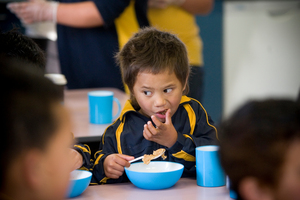 |
| Government grant to KidsCan for free breakfasts in D1-4 schools: $150,000 |
Stop with the grubby snarking in the House. TURN UP TO PARLIAMENT AND DO YOUR JOB. some of you have an attendance rate that would get us fired from our places of work, if we're lucky enough to have one. Look at the issues that actually matter. Do I care about some dinner some woman with a tinplate haircut attended with some chairman? Not really. I do care that every column inch dedicated to her hors-d'oeuvres is a column inch that's not asking you how you're going to ensure that every Maori boy gets an equal shot at education as the snottiest Takapuna Grammar girl. I want to see you pull your tongue out from between the cheeks of the investors who give no regard for either our tangata or our whenua (and definitely not for our tangata whenua) and instead get your hands dirty actually trying to make life better for everyone in your electorate, not just the ones who give anonymous cheques.
You can be a rich old white man and still have something worthwhile to say, if for once you stopped talking exclusively to other rich old white men.
There's fewer of them out there than you think.
Tuesday, 15 April 2014
Not for your convenience: Professional Development, Holidays, and what schools are actually for
For those of you who haven't met him,
let me introduce you to the English shadow spokesman for education,
Tristram Hunt (a man who, as my UK counterpart once said, is in grave
danger of becoming his own rhyming slang). Now young Tristram has one
job as long as his party are not in power, and that job is to not act
like the current education minister, a bottom-feeding polyp by name of
Michael Gove. That's it. Don't be like the most hated man in education,
and you'll find that a huge voting block swings behind you.
So, what has the young Hunt done? He's looked at a labour sector rife with teachers suffering from stress and long hours, of children under intense pressure to pass archaic and confusing assessments, at the dismantling of public education in favour of "free" schools, and decided to take a swipe at.....
Professional Development.
Parents, according to this man who has clearly never developed in any way, let alone professionally, are "baffled" about why a group of postgraduates in a professional career may occasionally need time for staff training. This pronouncement was backed by a handwringing helicopter spokesmum from website Netmums (note, not mumsnet, which carries more political clout than most print newspapers) who said that staff-only days are "Awkward" for parents (note, not caregivers. If you're not the parent then clearly you don't need representation at this level). She went on to say that she was "suspicious" of the timing of staff only days, as they are usually after holidays or weekends.
 |
| "Yummy mummies love Sherlock, don't they?" |
So, what has the young Hunt done? He's looked at a labour sector rife with teachers suffering from stress and long hours, of children under intense pressure to pass archaic and confusing assessments, at the dismantling of public education in favour of "free" schools, and decided to take a swipe at.....
Professional Development.
Parents, according to this man who has clearly never developed in any way, let alone professionally, are "baffled" about why a group of postgraduates in a professional career may occasionally need time for staff training. This pronouncement was backed by a handwringing helicopter spokesmum from website Netmums (note, not mumsnet, which carries more political clout than most print newspapers) who said that staff-only days are "Awkward" for parents (note, not caregivers. If you're not the parent then clearly you don't need representation at this level). She went on to say that she was "suspicious" of the timing of staff only days, as they are usually after holidays or weekends.
 |
| We do so little work as it is, let's add in some extra days for skiving! |
Where to start with this torrent of patronising bollocks?
Dear
Netmums, real mums, politicians and journalists looking to give
something else a kicking now Judith Collins and the Maori party are old
hat: Schools do not exist for your convenience.
Schools are not office-hour holding pens so you don't
need to pay for childcare for 40 weeks of the year. Teachers are not
babysitters with diplomas whose sole role is to keep little Foccacia and
Mumford out of your hair while you work on your career in marketing.
The education system does not exist for your convenience.
Our role is to educate your child. To socialise them, to
give them the skills they need to operate in the same society that you
are busy working in. How well this is done is a discussion for another
time, but that is at the core of what we do. In order for us to do that
effectively, sometimes we need to have training to improve our
performance. You don't stand outside your local opticians that's closed
for staff training on Wednesday
mornings, banging on the glass demanding that you either be let in or
that they post up exactly what is happening in there, as it's "awkward"
for you not to pick up some contact lens solution at that moment.
 |
| Of course, if working class kids were allowed to work, then all these inconveniences would disappear! |
Same goes for holidays. You may be a successful 35 year
old careerist who never gets tired ever, but your six year old, who is
learning the fundamentals of reading, of becoming a person, does. They
need that time out of class to be kids, to absorb and reflect on what
they've learned over the previous eleven weeks. It's not always about
your convenience, it's about (you guessed it) the needs of the children
who are ultimately the most important people in all this, and
incidentally the ones who are talked about the least.
Now I'm not saying that holidays and staff only days
aren't a pain in the arse for caregivers. But to hear politicians
promote resentment at teachers for wanting to improve their teaching,
and education ministers attempt to legislate longer terms and hours
to better suit working parents, shows just how little regard they hold
teachers and the education system in. Perhaps instead of attacking
teachers, netmums and their ilk need to consider the societal conditions
that have led to them require so much childcare in the first place.
Thursday, 27 March 2014
Powerless at the Chalkface
Teachers,
don't we get a sweet deal. Our short hours. Our long holidays. Our
glorified, overpaid babysitting job, when kids pretty much teach
themselves all that mickey-mouse shit these days anyway, not like the
real subjects kids used to learn. The odious nonsense about teaching, a
career so singled-out for media scorn and political hacky-sacking, is so
pervasive that we teachers even believe it ourselves. We buy in to the
idea that we should be grateful to have our jobs, and wake up every
morning with a smile on our faces and a song in our hearts, thankful
that we have such a gentle, not-even-a-real-job career that pays enough
that usually we only need the one job.
As anyone who knows anything about human nature might surmise,
this attitude causes problems when it butts up against the realities of
the modern chalkface. We are told in the gaslighting style of an
abusive partner that our jobs are easy, that we're slackers, that we're
letting the side down. While this constant stream of ego-mashing abuse
is whispered in our ears, we're given yet more chores to perform, given
new rules often without being told fully what they are till they're
broken, have targets set higher and further away than make sense or are
feasible (because everyone can be above average, right?). Every so
often, we are paraded in front of unfeeling strangers who judge us on
nothing beyond a quick leer and a ticked box.
All the while, we are told to say yes. To be compliant. Your
student's parents can only make a 7pm meeting? Then you must say yes,
and sit alone in a silent classroom for parents who may or may not come
to a ten minute chat about results they've already seen. The government
decides to completely change their focus so everything you've worked on
creating and resourcing before is now useless? Smile, nod and get back
to that drawing board, often late at night once your kids are in bed.
We are made to guilty for being human beings outside the
classroom. A day off is not taken lightly, our sick days and illnesses
carefully weighed up against the feeling of letting our classes and our
colleagues down. Relief work is set late at night with splitting
headaches or between frantic trips to the toilet, and often the decision
is made to just go in anyway. I once broke my ankle and was frantically
texting my relief for the next day as they wheeled me into X-ray. Even
high on morphine the shame of taking a sick day with chores undone was
too great.
I'm done with saying yes.
.jpg) |
| We look like this just before we burst into song, you know |
 |
| "The children seemed to act unnaturally when we were all in the room. Poor classroom management!" |
 | |
| "...and year 12 should do page....AAAAAARGH!" |
We're denied time to to attend weddings, funerals, life
events of those we love, because much as we try, sometimes real life and
externally-set holidays do not always synchronise. We can be refused
unpaid leave for no reason at all, despite our reasons being the most
joyous, the most humanly valid. Hindu? No unpaid day at home with your
family to prepare Diwali's feast for you, no matter how many of your
colleagues offer to step up. Daughter arriving home for the
first time in years? Hope that flight gets in outside of school
hours or she'll be taking a taxi home while you try to concentrate on
teaching 8C how to draw graphs.
In a world that increasingly seeks to divorce the demands of work from the basic human need to raise children, those who are told to raise them in your absence are treated with a level of professional and social disdain that makes it a wonder we're trusted with children at all. This discordant, manipulative relationship between teacher and system leaves us bewildered, exhausted, and ready not so much for divorce as a midnight flight to freedom.
 |
| Your ancient celebration of light is too foreign, no day off for you! |
In a world that increasingly seeks to divorce the demands of work from the basic human need to raise children, those who are told to raise them in your absence are treated with a level of professional and social disdain that makes it a wonder we're trusted with children at all. This discordant, manipulative relationship between teacher and system leaves us bewildered, exhausted, and ready not so much for divorce as a midnight flight to freedom.
 |
| "At least in the private sector we'll be considered hardworking!" |
After nearly a decade wielding a whiteboard marker, I am
nearly done. Not with the profession, to which I have a burning desire
to keep doing until I'm no longer enjoying the thrill of helping young
people learn new things, but with the culture. I'm done with acting like
my job is worth more than my mental wellbeing. I'm done with putting
the capricious demands of ministers and committees ahead of the needs of
the students I work with.
I'm done with saying yes.
Monday, 3 February 2014
Only white people get jobs? Representation in career advice
Today at work my students were investigating possible careers in science, technology, engineering and maths (STEM), something that's a bit of a buzzacronym in employment and political circles. The class of 14 year olds were taking the Career Quest questionnaire on the government's careers advice website. The questionnaire is not dissimilar to the old pencil-and-cross-out-the-answer careers advice sheet I did half a lifetime ago, though this one was all flash graphics and instant choose-your-own-future. Each of the 78 questions were on a separate web page can came with three photographs to illustrate the possible jobs the question was asking about. So far, so pretty.
I was talking to a group of girls who were taking the quiz when I noticed something. Every person in every photo was white. White man in hard hat. White women at computer. White person in labcoat. I asked the girls if they'd noticed any people in the photographs who weren't white. They said they hadn't, and I asked them to let me know when they did.
A few minutes later, this absolute gem of an observation was made.
"Miss, miss! I found a brown person! They're sitting being spoken to by a white person!"
The students were righteously concerned that in a quiz designed for young New Zealanders to choose a possible career path, people of colour did not seem to be represented in any of the possible careers. "Are we not supposed to have a career then miss?" was the half-joking question another asked me.
Having done the questionnaire myself, I did a little breakdown of representation. I tallied up the number of Asian (including Indian), Māori/Pasifika, and other people of colour actually carrying out a job. Customers, students and patients were not included. If I was in any doubt then I counted it as a positive ID. I appreciate that my labels are extremely broad and problematic in themselves but I beg understanding for the purposes of this quick and dirty research.
The results were depressing.
Of a total of 234 photographs in the quiz....
7 showed Asian people
16 showed Māori/Pasifika people
3 showed people of colour
There were more photos of inanimate objects than black people.
No photos showing people with disabilities.
I am a forgiving sort and will assume that this whitewashing of the NZ workforce was the result of error, rather than a deliberate attempt to make it look like only white people get jobs. However, we live in a country where, according to the last census, three quarters of the country identify as white/pakeha, just under 15% as Māori and nearly 12% as Asian. Hardly proportional.
If you're reading this thinking "So what? It's a quiz on a website", then think about who it's aimed at. Think about the state-supported drip-feed that subtly reinforces that only white people are employable, that every kid who is thinking of their future sees on page after page the same stereotype.
I was going to write to careers NZ to point this out, but seeing as my pack of 14 year olds are keen to exercise their right to call this stuff out, I'm going to let them do it. They're bound to do a far better job than me anyway, after all, they're the ones not being represented....
 |
| Google image search "doctor" on first page. Photo description "Happy afro doctor portrait". Er. |
I was talking to a group of girls who were taking the quiz when I noticed something. Every person in every photo was white. White man in hard hat. White women at computer. White person in labcoat. I asked the girls if they'd noticed any people in the photographs who weren't white. They said they hadn't, and I asked them to let me know when they did.
A few minutes later, this absolute gem of an observation was made.
"Miss, miss! I found a brown person! They're sitting being spoken to by a white person!"
 |
| Google image search "manager photo Asian". Guess what you get if you only use the first two words |
The students were righteously concerned that in a quiz designed for young New Zealanders to choose a possible career path, people of colour did not seem to be represented in any of the possible careers. "Are we not supposed to have a career then miss?" was the half-joking question another asked me.
Having done the questionnaire myself, I did a little breakdown of representation. I tallied up the number of Asian (including Indian), Māori/Pasifika, and other people of colour actually carrying out a job. Customers, students and patients were not included. If I was in any doubt then I counted it as a positive ID. I appreciate that my labels are extremely broad and problematic in themselves but I beg understanding for the purposes of this quick and dirty research.
 |
| Google search "stock photo teacher". First page! |
The results were depressing.
Of a total of 234 photographs in the quiz....
7 showed Asian people
16 showed Māori/Pasifika people
3 showed people of colour
There were more photos of inanimate objects than black people.
No photos showing people with disabilities.
I am a forgiving sort and will assume that this whitewashing of the NZ workforce was the result of error, rather than a deliberate attempt to make it look like only white people get jobs. However, we live in a country where, according to the last census, three quarters of the country identify as white/pakeha, just under 15% as Māori and nearly 12% as Asian. Hardly proportional.
 |
| "Stock photos disabled". First photo showing a person in a wheelchair not being pushed by an able-bodied person. Or alone looking sad. |
If you're reading this thinking "So what? It's a quiz on a website", then think about who it's aimed at. Think about the state-supported drip-feed that subtly reinforces that only white people are employable, that every kid who is thinking of their future sees on page after page the same stereotype.
I was going to write to careers NZ to point this out, but seeing as my pack of 14 year olds are keen to exercise their right to call this stuff out, I'm going to let them do it. They're bound to do a far better job than me anyway, after all, they're the ones not being represented....
Sunday, 2 February 2014
Do U even twitter bro?
New Zealand commercial radio is a strange and lawless place. Our Prime minister adores it and is far more likely to be answering questions about whether he prefers vegemite or marmite on a classic hits breakfast show than he is discussing charter schools on our chronically underfunded yet vaguely intelligent public broadcast news programs. Breakfast shows offer listeners the chance to win divorces, wives (not at the same time) and drivetime noodleheads appear in Pride parades after losing bets on-air. As you can imagine many of these professional journalists have their own twitter accounts, and I enjoy not following any of them on my timeline.
This evening, a young purveyor of opinion by name of Polly Gillespie, whose twitter bio invites us to listen to her on the breakfast show on ZM, as well as her columns in that august organ Women's Day, tweeted
Naturally, the idea of someone hating on Asians wishing to visit New Zealand's most famous beach that isn't ninety miles long being espoused by a national radio presenter is rather concerning and I could help but wonder what her employers ZM and Women's Day might think about this. The more I read her feed however, the righteous leftie anger turned to a kind of pitying rage. When called on her missive by the twitter populace, her responses ranged from:
(apparently tweeting racist things is fine if you're a fan of reality TV)
(because the best way to react when being called out is with smilies and referring to social media buttons as twins)
(because calling out racism makes you creepy weirdo. Like that Mandela guy)
Over the course of many emoticons, kisses and indignation later it transpired that our heroine had been watching Piha Rescue and was concerned about the perceived high number of Asian people who seemed to need rescuing on the show. Her tweet was actually a suggestion that all visitors to our shores should be properly educated in surf safety lest they require the services of the brave men and women of Surf Rescue.
As I type this Ms Gillespie (Wife, mummy, dork) is describing her detractors as "crazy" (oh dear) and retweeting all the other watchers of Piha Rescue who, like, totally got what she meant. At present neither ZM or Women's Day haven't said whether they think their star presenter/columnist is actually very racist, or only slightly racist and very naive, but I'd hope they'd at least be having a please explain meeting tomorrow morning.
There's a lesson here for all of us, regardless of whether we earn our crust being a professional minor celeb or merely use twitter to post pictures of cats. Your 140 characters ARE your context. If you don't want to sound like a racist, don't write something that looks racist.
This evening, a young purveyor of opinion by name of Polly Gillespie, whose twitter bio invites us to listen to her on the breakfast show on ZM, as well as her columns in that august organ Women's Day, tweeted
Seriously "stay away from Piha" flyers need to be given to people getting off the plane from Asian continent. #Pihahatesyoubro
— Polly Gillespie (@pollyggillespie) February 3, 2014
Now, twitter is a strange and terrible beast. You only have 140 characters to get across your thought. This thought, hashtag and all, looks racist. If I need to unpack why then you're probably reading the wrong blog.Naturally, the idea of someone hating on Asians wishing to visit New Zealand's most famous beach that isn't ninety miles long being espoused by a national radio presenter is rather concerning and I could help but wonder what her employers ZM and Women's Day might think about this. The more I read her feed however, the righteous leftie anger turned to a kind of pitying rage. When called on her missive by the twitter populace, her responses ranged from:
Does anyone actually WATCH Piha Rescue?? (Rolls eyes)
— Polly Gillespie (@pollyggillespie) February 3, 2014
(apparently tweeting racist things is fine if you're a fan of reality TV)
Ban and block are my favourite twins! (Though I'm quite find of Mary-Kate and Ashley) :))
— Polly Gillespie (@pollyggillespie) February 3, 2014
(because the best way to react when being called out is with smilies and referring to social media buttons as twins)
@Kevthesecond some people sit and wait like creepy weirdos....they should make 'creepin' a course. It amuses me....then I ban 'em! :)) xxx
— Polly Gillespie (@pollyggillespie) February 3, 2014
(because calling out racism makes you creepy weirdo. Like that Mandela guy)
Over the course of many emoticons, kisses and indignation later it transpired that our heroine had been watching Piha Rescue and was concerned about the perceived high number of Asian people who seemed to need rescuing on the show. Her tweet was actually a suggestion that all visitors to our shores should be properly educated in surf safety lest they require the services of the brave men and women of Surf Rescue.
Terrible if my tweet seemed racist. I think if you knew me OR watched Piha Rescue you'd know I'm not. Back to Instagram & kittens for me! :)
— Polly Gillespie (@pollyggillespie) February 3, 2014
This fascinates me because the woman is a professional journalist. Regardless of how quality you may consider those outlets to be, she has at some point I am sure attended at least a couple of night classes on writing things and then saying them out loud to people. Surely, surely at some point the idea that using something like twitter to make a comment that absolutely does not work out of context (and barely works within it if I'm honest, but I'm trying to be nice) was discussed and it was explained why it would be phenomenally stupid to do so?As I type this Ms Gillespie (Wife, mummy, dork) is describing her detractors as "crazy" (oh dear) and retweeting all the other watchers of Piha Rescue who, like, totally got what she meant. At present neither ZM or Women's Day haven't said whether they think their star presenter/columnist is actually very racist, or only slightly racist and very naive, but I'd hope they'd at least be having a please explain meeting tomorrow morning.
There's a lesson here for all of us, regardless of whether we earn our crust being a professional minor celeb or merely use twitter to post pictures of cats. Your 140 characters ARE your context. If you don't want to sound like a racist, don't write something that looks racist.
Thursday, 30 January 2014
Collins, Turei and Racism
Ugh, you can tell we're in an election year. The cellophane is barely off the new stationery for the term before the bitter fighting and mudslinging between parties and politicians begins. National, bless them, have decided that the electorate are shallow enough to vote based on character digs rather than policies and so Judith Collins' vicious little takedown of Green co-leader Metiria Turei this week comes as no surprise, as does John Key leaping to her defence.
The #nzpol hashtag is alive with this so feel free to check it out if you care enough but the main point I take from all this is that Judith, you are a racist.
There you go sweetheart, this is a callout.
Your insinuation that a Maori woman cannot speak for people in poverty dressed as a professional politician is a twofold slap in the face. If Turei turned up in jandals and cutoffs you and your bitter pointy-shouldered cronies would cackle and point in your contempt for someone not taking their role seriously. You would dismiss her out of hand. If Turei, a former lawyer and advocate for beneficiaries, dares to dress in the clothes of a professional in a country that clings to European standards of formality, then you label her a hypocrite as since when did anyone currently successful ever understand the realities of poverty? The suggestion that a Maori woman should not get ideas above her station is subtle, but there. (It also smacks of a classist assumption that people in poverty are somehow "other" but that's a whole other post.) Her follow-up patronising comments to Turei after being called out is classic privilege. Put someone down, then suggest the wounded party is just oversensitive. "A sensitive little sausage" Judith? This is really how you publicly address another MP?
It is hard enough for a woman in politics to be taken seriously, as Jacinda Ardern's recent comments on the sexism she's faced as an MP testify, without facing the intersectionality of being Maori and female. The fact she's currently popular with media and public is the final provocation for a party that thrives on holding down others to benefit the minority of business cronies and schoolboy networkers. Judith's open admiration for that odious pit of despair and hatred that is Whaleoil (no, I'm not linking) should speak volumes all by itself.
The election is strongly rumoured to be held in September, giving us another seven months of backbiting and personal grudges. One would hope that voters consider what qualities they want in the people who represent them. Are racism and the gleeful snarking at others really the traits we think represent us best?
 |
| A professional. Dressed professionally. |
The #nzpol hashtag is alive with this so feel free to check it out if you care enough but the main point I take from all this is that Judith, you are a racist.
There you go sweetheart, this is a callout.
Your insinuation that a Maori woman cannot speak for people in poverty dressed as a professional politician is a twofold slap in the face. If Turei turned up in jandals and cutoffs you and your bitter pointy-shouldered cronies would cackle and point in your contempt for someone not taking their role seriously. You would dismiss her out of hand. If Turei, a former lawyer and advocate for beneficiaries, dares to dress in the clothes of a professional in a country that clings to European standards of formality, then you label her a hypocrite as since when did anyone currently successful ever understand the realities of poverty? The suggestion that a Maori woman should not get ideas above her station is subtle, but there. (It also smacks of a classist assumption that people in poverty are somehow "other" but that's a whole other post.) Her follow-up patronising comments to Turei after being called out is classic privilege. Put someone down, then suggest the wounded party is just oversensitive. "A sensitive little sausage" Judith? This is really how you publicly address another MP?
It is hard enough for a woman in politics to be taken seriously, as Jacinda Ardern's recent comments on the sexism she's faced as an MP testify, without facing the intersectionality of being Maori and female. The fact she's currently popular with media and public is the final provocation for a party that thrives on holding down others to benefit the minority of business cronies and schoolboy networkers. Judith's open admiration for that odious pit of despair and hatred that is Whaleoil (no, I'm not linking) should speak volumes all by itself.
The election is strongly rumoured to be held in September, giving us another seven months of backbiting and personal grudges. One would hope that voters consider what qualities they want in the people who represent them. Are racism and the gleeful snarking at others really the traits we think represent us best?
Subscribe to:
Posts (Atom)